The Wi-Fi industry is moving to the cloud, and with that shift comes important questions about security, compliance, and data protection. In our recent webinar with Jennifer (JJ) Minella, we explored what it takes to run cloud-based Wi-Fi tools securely, why compliance certifications matter, and what you should look for when choosing cloud-based solutions.
Jennifer Minella is the founder of Viszen Security and the author of Wireless Security Architecture (2022). She has been named one of cyber security's Top 10 Power Players and has served as an advisor to some of the word's largest companies.
You're already using cloud-based tools
Many Wi-Fi professionals are already using cloud-based tools, whether they realize it or not. If you're doing site surveys with an iPhone or iPad, you're probably using cloud infrastructure to sync your data.
Cloud-managed Wi-Fi vendors have become the norm, and productivity suites like Google Workspace and Office 365 have made cloud computing a standard part of business operations. This widespread cloud adoption makes security and compliance frameworks more critical than ever.
So, the question is quickly moving from whether to use the cloud to how to use it securely.
Why compliance certifications matter
When Hamina began pursuing ISO 27001 certification and SOC 2 Type 2 auditing, the process revealed just how critical these certifications are for cloud-based tools. These aren't just badges to display on a website - they're comprehensive frameworks that fundamentally change how a company operates.
Understanding the difference
It's important to clarify the terminology. ISO 27001 results in a certification - an official recognition that you've implemented and maintain specific security standards. SOC 2, on the other hand, is an audit that produces a report. While the terminology differs, both serve the same critical purpose: proving that a company handles customer data responsibly.
Jennifer Minella explains: "All of the vendors you're using are storing or processing some of your information. So the question is; what information are they collecting, processing, storing and transmitting? How risky is that? And, what is your level of confidence in how they're handling that data?"
The real-world impact
The value of these certifications becomes clear when you're trying to get a new tool approved by your security team. Without proper certifications, engineers often face extensive questionnaires - sometimes spreadsheets with hundreds of questions about data handling, encryption, storage practices, and security protocols.
With ISO 27001 certification and a SOC 2 Type 2 report available through a trust center, that process dramatically simplifies. Security teams can access the information they need directly, bypassing weeks of back-and-forth communication and approval processes.
What gets audited
Understanding what these certifications actually cover helps explain why they matter so much.
- Technical infrastructure
Auditors examine the entire technical stack - from the cloud platform choice (like Azure or AWS) to how data is encrypted at rest and in transit. They verify that authentication systems are properly implemented and that API communications are secure. This isn't a paper exercise - auditors actually test these systems to confirm they work as documented. - Operational Processes
Compliance extends far beyond technology. Auditors review hiring and firing practices, how employees access sensitive systems, physical security at offices, and how companies handle security incidents. They examine the entire lifecycle of how data flows through an organization. - Business Practices
Even product development processes fall under scrutiny. Who decides what features get implemented? How are those decisions documented? What happens when a customer requests data deletion? These operational details all factor into compliance certifications.
The journey to certification
Pursuing ISO 27001 and SOC 2 Type 2 isn't a quick process. For Hamina, it took months of preparation, implementation, and auditing. The process touched every aspect of the business, from how engineers work to how the company handles physical security.
One initial concern was whether these frameworks would reduce agility. However, the experience showed that good auditors work as allies, helping organizations implement sensible security measures rather than creating unnecessary obstacles.
Wi-Fi security in the cloud era
The cloud migration intersects with ongoing Wi-Fi security evolution, creating new considerations for network architects. As networks move to the cloud, security requirements become more complex, requiring careful attention to both established standards like WPA3 and emerging technologies like Wi-Fi 7.
Transitioning to WPA3
WPA3 adoption remains a significant hurdle, particularly for personal (passphrase-based) networks. While 802.1X-secured networks can relatively smoothly transition through WPA3 transition mode before moving to full WPA3, personal networks face more challenges with uncertified endpoints and IoT devices.
The security concern with WPA3 transition mode on passphrase networks is that you've effectively downgraded everything to WPA2 security. Since you're using the same passphrase, someone can still crack it over the air using well-known WPA2 vulnerabilities. This is why 802.1X-secured networks moving to WPA3 should enable transition mode temporarily, verify everything works, then move to full WPA3 - while passphrase networks need more careful consideration.
Wi-Fi 7 security requirements
Wi-Fi 7 introduces mandatory security requirements that many vendors haven't fully implemented yet. The standard requires GCMP256 for over-the-air encryption - a significant upgrade from the 128-bit encryption we've used for over 20 years.
This creates potential issues. Wi-Fi 7 access points still need to support Wi-Fi 6 and earlier clients, so they advertise both cipher suites. This dual-advertisement scenario hasn't been common since the TKIP days, and it's causing compatibility problems similar to the WPA3 personal friction we've experienced.
Practical benefits of cloud-based Wi-Fi tools
Beyond security and compliance, cloud-based Wi-Fi tools offer operational advantages that fundamentally change how network teams work.
Never save again
Cloud applications eliminate the save button entirely. All changes automatically persist in real-time. This might seem like a small convenience, but anyone who has lost hours of work to a corrupted file or application crash understands the significance.
The same principle extends to mobile survey applications. Data syncs automatically when connectivity is available, eliminating the risk of losing survey data from remote sites.
Instant collaboration
Traditional file-based workflows require emailing project files, managing versions, and ensuring everyone has the latest updates. Cloud-based tools enable instant sharing - type an email address, and colleagues anywhere in the world can access the project immediately.
This enables new workflows. A field engineer with only a survey license can collect data on-site, while a design specialist with a different license analyzes that data in real-time from across the globe. The tools adapt to how teams actually work rather than forcing teams to adapt to tool limitations.
No installation required
Browser-based tools eliminate installation hassles and permission issues. Organizations with locked-down security policies often struggle to approve local application installations that require administrator rights. Browser-based tools bypass these obstacles - if employees can use a web browser, they can use the tool.
This also ensures everyone always uses the latest version. No more checking for updates or dealing with incompatible file versions between team members.
Platform independence
Cloud tools work identically across Windows, Mac, Linux, and various browsers. Teams using different platforms collaborate seamlessly without compatibility issues or degraded experiences on particular operating systems.
Survey on your iPhone or iPad using the Onsite app and instantly review and analyze your results on the Planner web-app thanks to cloud.
Performance considerations
One common concern about cloud-based tools is performance - won't a browser application be slower than a native desktop app?
The reality proves counterintuitive. Cloud applications can leverage both local resources (CPU, RAM, GPU) and unlimited cloud computing power. Heavy computational tasks offload to the cloud, while real-time visualizations use local resources for instant responsiveness.
Modern browsers are essentially full operating systems. Browser-based applications can leverage both local resources and unlimited cloud computing power, with performance that matches or exceeds traditional desktop tools. The proof is in the experience - complex 3D visualizations, instant heat maps, and smooth interactions all work better than many traditional tools.
Cloud-to-cloud integration
Perhaps the most significant advantage of cloud-based Wi-Fi tools is their ability to integrate with other cloud services through APIs. These integrations not only improve efficiency but also enhance security posture by reducing manual configuration errors and enabling real-time monitoring.
Automated deployment
Cloud-based design tools can automatically deploy configurations to cloud-managed Wi-Fi infrastructure. Design your network, then push those configurations directly to your access points without manual configuration steps.
Live network analysis
API integration enables real-time network visibility without on-site presence. Import current access point locations, view live utilization data, troubleshoot client issues, and analyze network performance - all through API calls to your vendor's cloud platform.
This capability fundamentally changes network troubleshooting. Instead of traveling to sites for every issue, engineers can remotely analyze problems, test remediation strategies virtually, and only travel when physical presence is actually required.
Environmental learning
Advanced integration allows using live network data to improve simulation accuracy. The system learns RF propagation characteristics from operational networks, creating more accurate predictive models without requiring extensive site surveys or AP-on-a-stick validation.
What to look for in cloud tools
When evaluating cloud-based Wi-Fi tools, several factors deserve careful consideration:
- Security Certifications: Look for ISO 27001 certification and SOC 2 Type 2 reports. These demonstrate serious commitment to security and provide the documentation security teams need for approval.
- Transparency: Vendors should provide easy access to security documentation through a trust center. Full reports (not just redacted summaries) should be available to customers and prospects. Hamina provides this documentation through a dedicated trust center.
- Data sovereignty: Verify that the vendor can meet your geographic data requirements. Some organizations need data to stay within specific regions for regulatory compliance.
- Vendor integration: Check which Wi-Fi vendors the tool integrates with and what capabilities those integrations provide. Live analysis capabilities vary significantly between vendors.
- On-premises options: For military, defense contractors, or organizations that cannot have data in the cloud, verify whether on-premises deployment is possible. Most cloud tools can provide this, though it typically comes at significant cost.
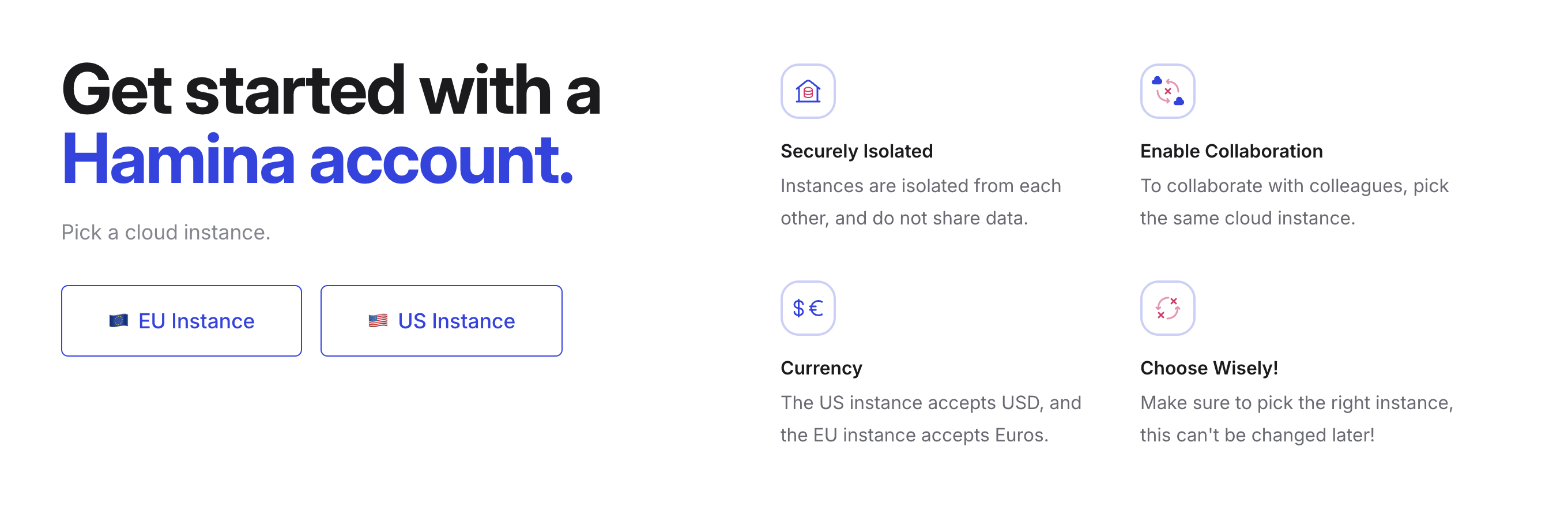
With Hamina, you can choose where your data will be stored - within the EU or US.
The future of cloud-based Wi-Fi tools
Organizations have gone back and forth between on-premises and cloud solutions over the years, but the current trend toward cloud infrastructure appears sustainable. The combination of security frameworks, computational power, and integration capabilities makes cloud infrastructure increasingly compelling.
AI capabilities are accelerating adoption of cloud-based tools. Features like automatic floor plan scaling, wall detection, and attenuation prediction all benefit from cloud-based processing power. These capabilities would be difficult or impossible to implement effectively in traditional desktop applications.
However, some AI processing may shift back to local devices as large language models become smaller and more efficient. The newest laptops include AI-specific processors, and taking advantage of this local processing power makes sense for certain applications.
The likely outcome may involve more balance between cloud and local processing. As processors with AI capabilities become more common in laptops, some processing that currently happens in the cloud might shift to local devices. Cloud infrastructure will, however, continue to be important for heavy computation and storage.
Implementation considerations
Vendor support: Verify which cloud-managed Wi-Fi vendors your tools integrate with. The list continues expanding, but gaps may exist for less common platforms.
Licensing structure: Cloud tools often enable flexible licensing models. Field engineers might only need survey licenses while designers need planning licenses. This modular approach reduces costs and complexity.
Offline capabilities: Ensure mobile survey applications can work offline and sync later. Sites without connectivity are common, and tools must handle these scenarios gracefully.
Trust centers: Look for vendors that provide dedicated security portals where you can download compliance reports, review security practices, and access documentation your security team needs.
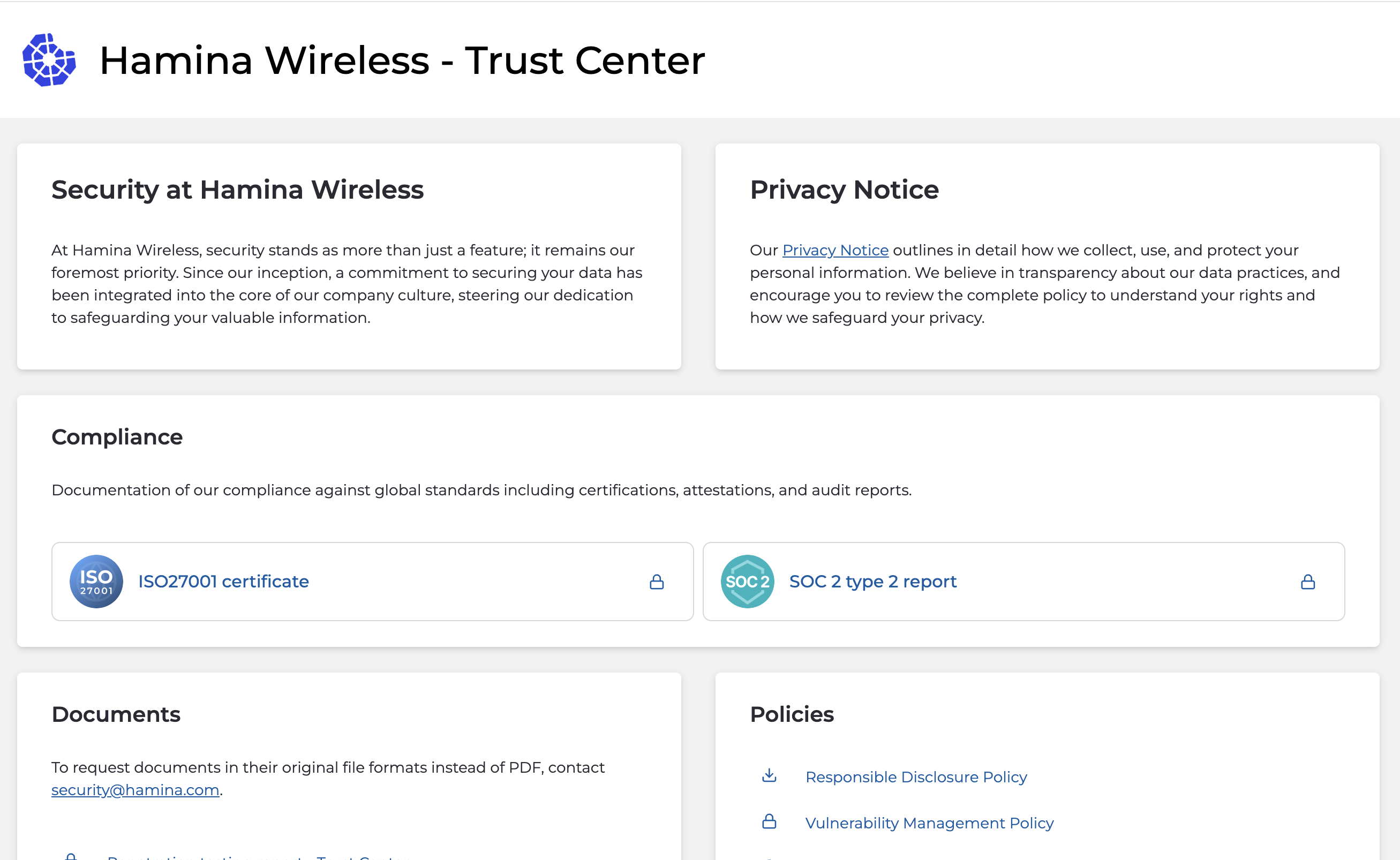 Have questions about security at Hamina Wireless? You can review our policies and find answers to most questions at trust.hamina.com
Key Takeaways
Wi-Fi tools are moving to the cloud, making security increasingly important. Organizations choosing cloud-based Wi-Fi tools need assurance that their data is handled responsibly, their security requirements are met, and their compliance obligations are satisfied.
ISO 27001 certification and SOC 2 Type 2 auditing provide that assurance. These aren't quick checkbox exercises - they're comprehensive frameworks that touch every aspect of how companies operate, from technical infrastructure to business processes.
For engineers evaluating tools, the existence of these certifications dramatically simplifies the approval process. For organizations providing cloud-based tools, pursuing these certifications demonstrates serious commitment to security and customer data protection.
The cloud offers significant advantages in collaboration, performance, and integration capabilities. When combined with proper security frameworks and compliance certifications, cloud-based Wi-Fi tools provide the functionality teams need and the security organizations demand.
As Wi-Fi continues evolving - with WPA3 adoption, Wi-Fi 7 deployment, and increasing integration between network infrastructure and management tools - the importance of security-first cloud platforms will only grow. Organizations making tool choices today should prioritize vendors that take security seriously enough to pursue comprehensive certification and make that documentation transparently available.
Is security and data privacy a priority for you?
If security and data privacy are a priority, you may want to ask your network tools provider if they're compliant, and if not, we're happy to talk!
For detailed information about our comprehensive security practices and certifications, visit our Trust Center, where you can also request access to our full security documentation, including our SOC 2 Type 2 report and ISO 27001 certificate.
Questions about our security practices? Contact us at security@hamina.com or visit our Trust Center for more information.
