When you need to deliver seamless wireless connectivity across 574 000 square feet of exhibit space for 15,500 attendees, there's not much room for error. And when you have less than a week to deploy it all, the planning better be spot-on.
That was the challenge facing SCinet, the team behind the network infrastructure powering Supercomputing Conference 2025 at America's Convention Center. The SCinet team is made up of volunteers from universities and national labs across the country - including PIER Group, which provided the majority of the equipment for wireless deployment.
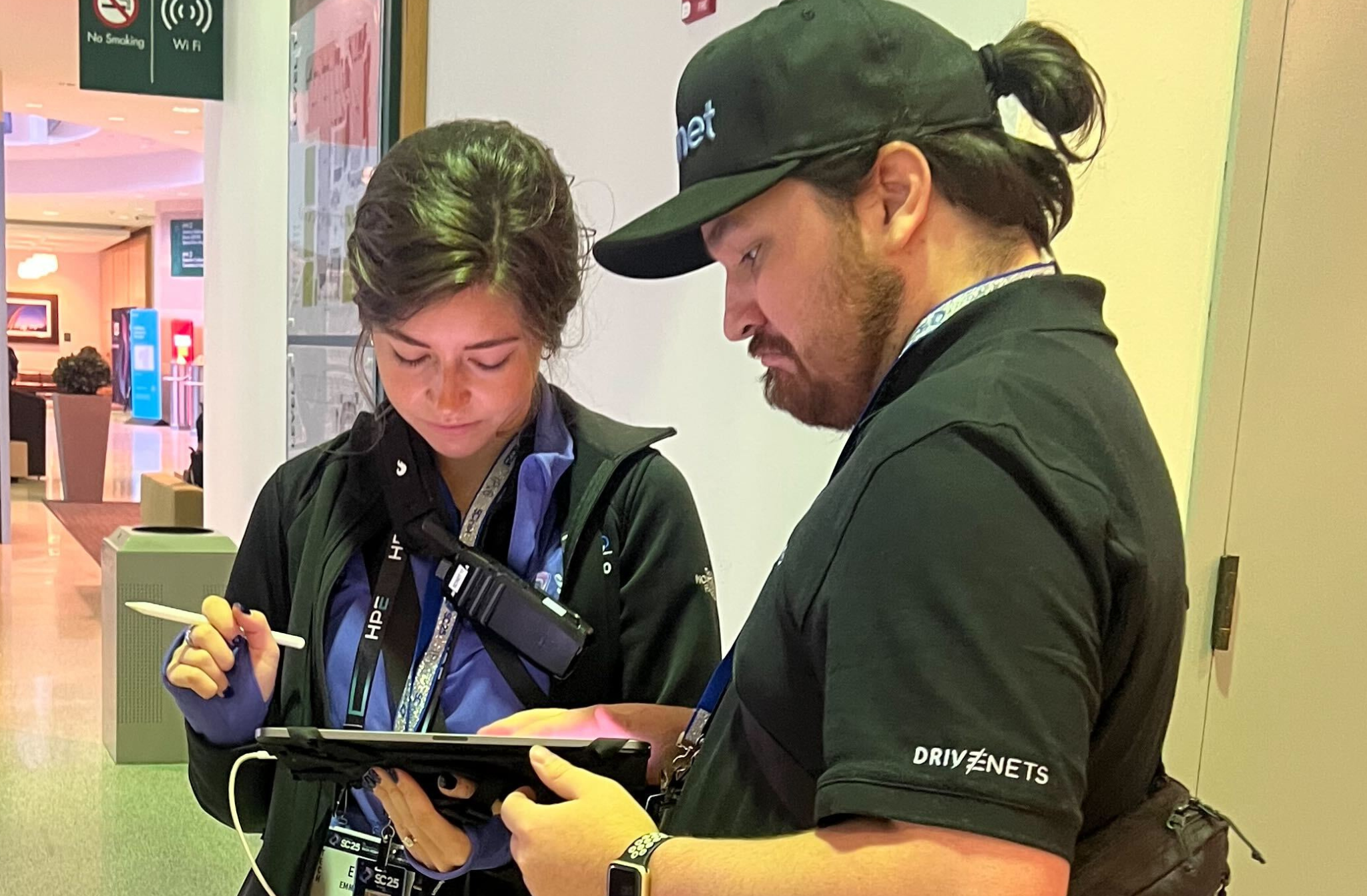
Hamina Wireless provided the team with Hamina Planner Plus and Onsite licenses for the design and validation work, while Oscium loaned the team Nomads for site surveys. For network management and deployment the team used HPE Aruba Networking Central (Classic and Next Generation), Arista Cloud Vision, and Arista Wireless.
With Hamina's tools the team was able to successfully plan and validate the network for the event. And for the first time ever, they received 0 complaints from the Keynote ballroom.
The Challenge
SCinet 2025 faced two major technical hurdles:
The Exhibit Floor: Over 574,000 square feet of exhibit space with close to 2 million square feet of total space. The booth layouts and the various materials used for booths were unknown ahead of time, and the flow of users was unpredictable.
The Keynote Space: A 2,500-seat ballroom requiring an underseat AP deployment. This year, the team designed and 3D-printed custom 25-degree underseat floor mounts specifically for the deployment.
Add to that the typical event network headaches: finding working existing cabling, dealing with cable breaks during booth construction, and less than a week to cover the majority of the space.
The Team
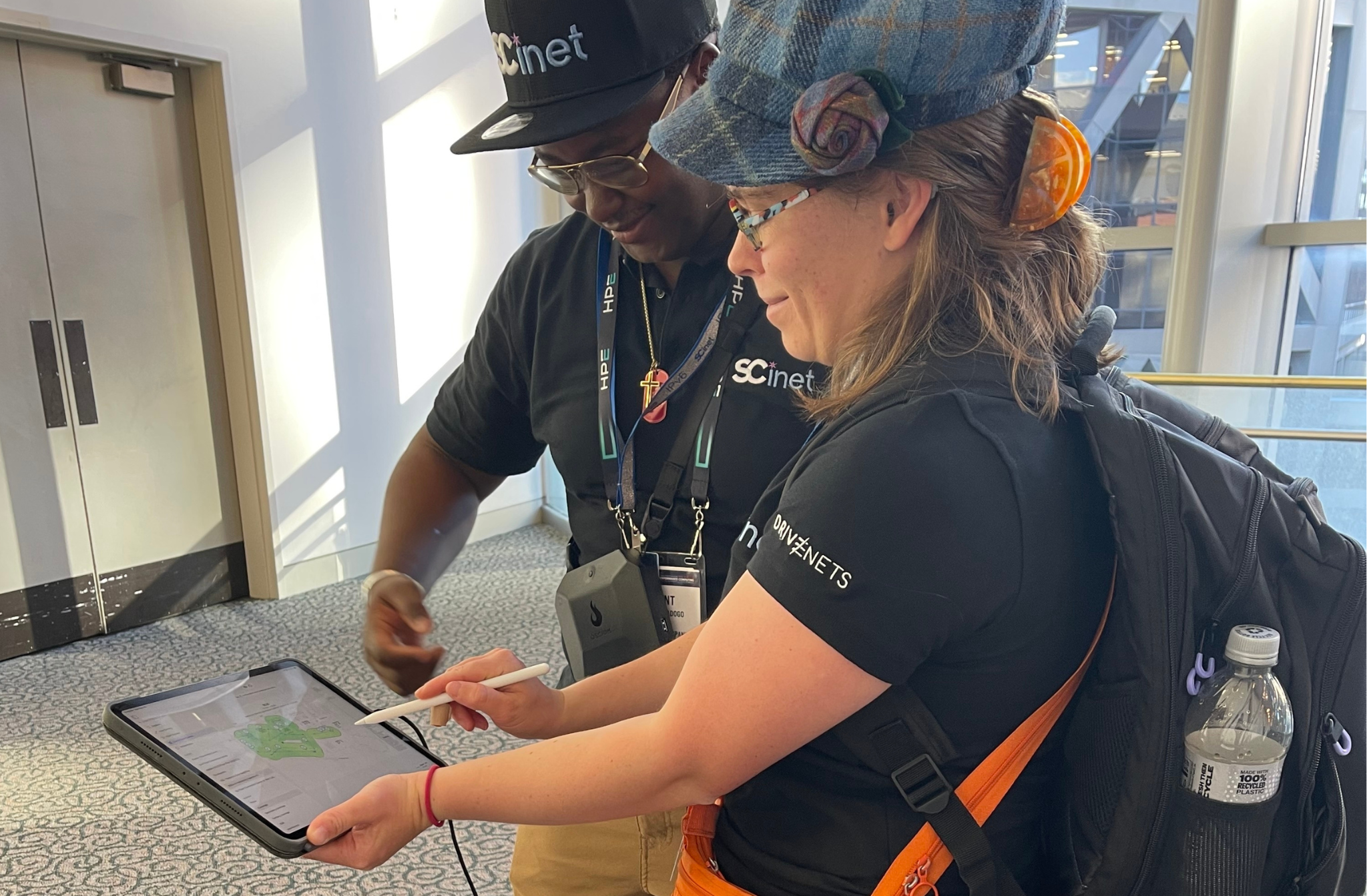
The volunteer team brought together wireless engineers, network engineers, students, and IT managers with a mix of junior and senior experience levels. Some had previous experience with competitor tools and/or Hamina tools, while others were new to network design and validation tools entirely.
Learning Hamina
After attending two online training sessions hosted by Hamina, the team was up and running quickly. The survey functionality took less than an hour to learn.
The team considered the most valuable features during the design phase to be 1) the ability to move a sample client around the space to test coverage scenarios and 2) the AI-generated walls that automatically outlined booth spaces on the exhibit floor.
As the team noted: "For a show floor, the AI-drawn walls are a game changer for getting outlines of booths."
Designs were shared among team members ahead of time, allowing everyone to review and reference the plans during the temporary deployment phase.
.png?width=672&height=386&name=image%20(14).png)
The network design created by SCinet in Hamina Network Planner
The Results
The network performed exactly as the team had predicted with Hamina Network Planner. There were no significant discrepancies between the design and actual deployment.
More importantly: zero complaints from the Keynote space for the first time ever. That's 2,500 people with seamless connectivity in an underseat deployment scenario that historically generated feedback.
From an RF perspective, the network performed well throughout the event. The Hamina plan allowed the team to confirm ahead of time that the network would work as expected. While there were some routing issues during the event, those turned out to be unrelated to the wireless design.
.png?width=672&height=386&name=image%20(15).png) Results of the survey performed with Hamina Onsite and Oscium Nomad
Results of the survey performed with Hamina Onsite and Oscium Nomad
Key Lessons
The team walked away with some solid lessons for future deployments:
- Print the plans. In a large temporary network setup, it's difficult to reference AP placements on a phone screen. Having printed copies of the Hamina designs would have made installation even smoother.
- Use Hamina for documentation too. Beyond planning, Hamina proved valuable for documenting the live network with AP placements for reference during and after the event.
- AI walls save time. For dynamic spaces like exhibit floors where booth layouts are unknown, Hamina's AI-generated wall detection significantly speeds up the design process and improves accuracy.
"Hamina is a great tool to estimate placement and get a good idea of the count of APs needed to cover a space. The ability to share read-only copies of plans to people without a license is a huge help."
About SCinet
SCinet is the volunteer-built network infrastructure that powers SC, the International Conference for High Performance Computing, Networking, Storage, and Analysis. Each year, volunteers from universities and national labs design and deploy one of the world's most advanced temporary networks to support the conference's demanding connectivity requirements.
